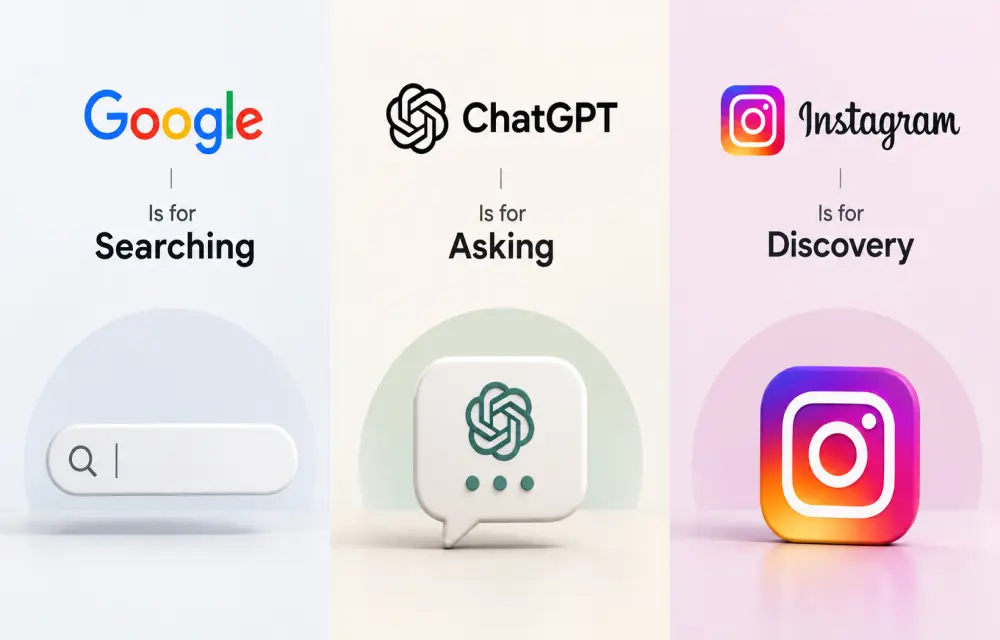
Google Is for Searching, ChatGPT Is for Asking, Instagram Is for Discovery: How Search Changed in 2026
By Rahul Vithala · · 10 min read
For a long time, the internet had a simple pattern.
If you wanted an answer, you opened Google.
You typed a question, looked through ten blue links, opened a few websites, compared information, and found what you needed. Search was about finding pages. The user had to do the work of reading, verifying, comparing, and deciding.
But in 2026, that behavior has changed.
Now, people still use Google for searching. But they use ChatGPT and other AI assistants for asking. They use Instagram, TikTok, YouTube, Reddit, LinkedIn, and even WhatsApp communities for discovery.
The internet is no longer one search engine with many websites. It has become a group of different “search behaviours,” each driven by a different psychological need.
Google is where people go when they know what they are looking for.
ChatGPT is where people go when they need help thinking.
Instagram is where people go when they do not yet know what they want but they want to find something interesting.
That is the real shift.
Search Is No Longer Only About Keywords
Traditional search was built around keywords.
People searched for:
-
Best laptops under ₹50,000.
-
How to fix iPhone storage full.
-
Best SEO tools.
-
Digital marketing agency near me.
-
How to start a blog.
Today, people still search these terms. But they also ask AI assistants questions in a more natural way:
“I run a small SaaS company. We have traffic but no qualified leads. What should we fix first?”
Or:
“I need a laptop for video editing, but I travel often and my budget is limited. Which models should I consider?”
The difference is psychological.
Google users often arrive with a destination in mind. They may know the product, the problem, the brand, or the exact question.
AI users often arrive with uncertainty. They need help to organize their thoughts. They do not only want information; they want interpretation, direction, comparison, and a clear next step.
This is why ChatGPT has become important. It does not replace Google for every task, but it changes the way people begin their research.
Google Is Still the Place for Verification
Google has not disappeared. It is still where people verify, compare, buy, research, and find official sources.
If someone wants the latest price of a phone, they may search Google. If they want to check product reviews, local businesses, flight timings, news updates, website troubleshooting, or official documentation, Google remains powerful.
But Google itself has changed.
With AI Overviews, users may receive a quick answer directly on the results page before visiting any website. That can be useful for simple questions, but it also changes click behavior. A Pew Research Center analysis of Google searches in March 2025 found that users were less likely to click links when an AI summary appeared. Only 8% clicked a traditional search result on pages with an AI summary, compared with 15% on pages without one. Users also rarely clicked the sources cited in the summaries.
This creates a new challenge for publishers and businesses. Ranking on Google is still important, but being visible is not always enough. Content must now be strong enough to earn trust, clicks, brand recognition, and repeat visitors.
A basic answer may be summarized by Google. But a practical guide, real review, case study, expert opinion, comparison, or detailed solution still gives people a reason to visit the original website.
That is why experience-based content matters more in 2026.
ChatGPT Is for Asking, Not Just Searching
People communicate with AI differently because it feels more personal than a search bar.
A Google search can feel like a command:
“Best CRM software.”
An AI conversation feels like a consultation:
“I have a five-person sales team, a limited budget, and we are losing leads from WhatsApp. Which CRM should we use and why?”
This is a major psychological difference.
People want less effort. They want fewer tabs. They want help filtering options. They want the answer to reflect their situation. AI tools feel useful because they reduce the mental workload of research.
Instead of reading twenty articles, users can ask a chatbot to summarize the choices. Instead of learning every technical term, they can ask follow-up questions. Instead of searching for “SEO strategy,” they can explain their business problem and ask for a plan.
However, AI should not be treated as the final source of truth. AI can misunderstand context, use outdated information, or make confident statements without enough evidence. Smart users still verify important details through official websites, product documentation, reviews, forums, experts, and Google Search.
This is where the new behaviour becomes interesting. People may ask AI first, then search Google to verify, then visit social media to see real opinions.
Search is now a journey, not one action.
Instagram Is for Discovery
Instagram is not a traditional search engine, but people increasingly use it to discover products, creators, trends, restaurants, travel ideas, tools, workouts, fashion, business advice, and new brands.
The psychology behind Instagram discovery is different from Google.
On Google, people often start with a need.
On Instagram, people often start with attention.
They are scrolling. They are watching Reels. They see a product demonstration, a founder story, a client transformation, a software tutorial, or a review. Then curiosity begins.
Someone may not wake up and search “best AI automation platform.” But after seeing a short video that shows how an AI voice agent handles customer calls, they may become interested. That is discovery.
Instagram works because it combines visual storytelling, social proof, repetition, and identity. People do not only ask, “Is this useful?” They also ask:
-
Does this feel relevant to me?
-
Do people like me use this?
-
Does this brand understand my lifestyle?
-
Does this look trustworthy?
-
Can I imagine myself using it?
That emotional connection is why visual platforms are powerful. They can create demand before a person searches for it.
TikTok Changed the Way Younger Users Discover
TikTok has pushed discovery even further. It is fast, personal, entertaining, and heavily driven by recommendation algorithms. Users do not always need to know what to search for. The platform keeps showing them things they may be interested in.
For younger users, TikTok is also becoming a news and information platform. Pew Research found that 43% of U.S. adults under 30 said they regularly get news from TikTok in 2025, up sharply from 9% in 2020.
This does not mean TikTok has replaced journalism or Google. It means younger users are comfortable learning through short video, creator explanations, visual proof, and conversational language.
A person may search Google for technical details. But they may watch TikTok first to understand whether a topic is worth caring about.
For brands, this means content cannot only be written for search engines. It must also be explained visually and simply.
YouTube Is for Learning Through Proof
YouTube sits somewhere between Google and Instagram.
It is a discovery platform, but it is also a research platform. People use it when they want to see something in action.
Before buying a phone, laptop, camera, microphone, software subscription, or hosting plan, many people watch YouTube reviews. They want to see the product. They want demonstrations, comparisons, real usage, screen recordings, and long-term opinions.
A written article can explain that a laptop has a good display. A video can show it.
This is why YouTube is strong for high-consideration decisions. It gives users a sense of proof. They can watch someone use the product, notice the problems, understand the context, and decide whether the reviewer feels trustworthy.
Pew data also shows that digital users regularly turn to platforms like Facebook, YouTube, Instagram, and TikTok for news and information, proving that search behavior is now spread across multiple channels rather than limited to search engines alone.
Reddit Is for Honest Opinions
Reddit has become a major platform for people who do not want polished marketing language.
When someone searches:
“Is this SaaS tool actually worth it?”
or
“What is the best WordPress hosting according to real users?”
They often add “Reddit” to the Google search.
Why?
Because people want unfiltered experiences.
They want to hear from users who have faced the same issue. They want complaints, alternative suggestions, pricing realities, hidden problems, support experiences, and long-term feedback. They do not want only the company’s official claims.
The psychology here is trust through community validation.
A Reddit comment may not be professionally written, but it can feel more believable because it seems independent. People value real experience over polished advertising.
For brands, this is a reminder that reputation cannot be built only with beautiful landing pages. Good products, reliable service, clear support, and honest communication matter.
LinkedIn Is for Professional Discovery
LinkedIn is different again. It is where people discover ideas, business services, professional expertise, career opportunities, founders, case studies, and industry conversations.
A business owner may not search Google for “digital marketing agency” immediately. They may first see a LinkedIn post explaining why a website is getting traffic but not leads. If the post feels useful, they visit the profile, check the company page, read more content, and start building trust.
LinkedIn discovery is often slower, but it can be more valuable for B2B businesses. People are not only looking for a service. They are evaluating expertise.
This is why founders should share real lessons, client observations, case studies, mistakes, and practical viewpoints. Generic motivational posts may get likes, but clear expertise creates business credibility.
Facebook Still Supports the Ecosystem
Some people call Facebook outdated, but its role is still important especially for local communities, groups, older audiences, events, business pages, and Meta advertising infrastructure.
Facebook and Instagram are connected through Meta’s business ecosystem. A brand may use Instagram for visual discovery but still need Facebook Pages, Meta Business Suite, and Ads Manager for campaign management, audience targeting, lead generation, reporting, and account access.
Facebook may not always be the platform where a young creator spends most of their day. But for many businesses, it remains part of the backend system that supports paid growth and customer communication.
Search Has Become Behavioral
The biggest transformation in 2026 is not technological. It is behavioral.
People now choose platforms based on what they feel they need at that moment.
When they need a fact, they search Google.
When they need advice, they ask ChatGPT.
When they need inspiration, they open Instagram.
When they need entertainment and quick discovery, they use TikTok.
When they need a demonstration, they watch YouTube.
When they need honest opinions, they check Reddit.
When they need professional credibility, they browse LinkedIn.
When they need community conversation, they may still use Facebook groups or WhatsApp communities.
This means businesses can no longer depend on one channel. A website alone is not enough. Social media alone is not enough. AI visibility alone is not enough.
A strong digital presence needs all three layers:
-
Search visibility for people actively looking.
-
AI-ready content for people asking detailed questions.
-
Social discovery for people who have not started searching yet.
What This Means for Businesses
Businesses need to stop asking, “Which platform is best?”
The better question is: “What is my customer trying to do on each platform?”
A customer may discover your brand on Instagram. They may watch your product review on YouTube. They may search your company name on Google. They may ask ChatGPT to compare you with competitors. They may check Reddit reviews before buying. They may visit LinkedIn to evaluate your founder or business credibility.
That is the modern customer journey.
For TheTechHacker Global Solutions, this is why we see marketing as a connected system. SEO helps you appear when people search. Content helps you answer when people research. Social media helps you become discoverable. Websites help you convert attention into action. AI tools and automation can help businesses respond faster and work more efficiently.
The future of search is not about replacing Google with ChatGPT or Instagram. It is about understanding why people use each platform differently.
Google is for searching. ChatGPT is for asking. Instagram is for discovery.
The brands that understand this psychology will not chase every platform blindly. They will create the right message for the right moment and make it easy for people to trust them wherever the journey begins.